
How Managed Communities Are Solving the Biggest Pain Point for Second-Home Owners

How Managed Communities Are Solving the Biggest Pain Point for Second-Home Owners

By Holistic Group | Real Estate & Lifestyle | March 2026

Imagine owning a stunning villa nestled in the lush hills near Mumbai — a personal retreat where weekends feel like resort stays, and every visit recharges your spirit. Now imagine returning to the city on Sunday evening only to receive a frantic call: the water pump has broken, the caretaker quit, and the monsoon has leaked into the living room ceiling.

For most second-home owners in India, this isn’t a nightmare — it’s just ownership without management.

The promise of a villa as a second home is compelling. The reality of managing one remotely is anything but. However, a new wave of managed villa communities is fundamentally transforming this experience — and Holistic Group’s projects near Mumbai are at the forefront of this shift.

The Real Pain Points of Second-Home Ownership in India

Owning a villa as a second home in India is a dream shared by millions of urban professionals and NRIs. Yet the gap between aspiration and reality can be enormous. Here are the core challenges that make second-home ownership frustrating:

  • Ongoing Maintenance Burden: Unlike a primary city apartment managed by a housing society, a standalone villa places the entire upkeep responsibility on the owner. Experts recommend setting aside 1–2% of the property value every year for routine and unexpected repairs — a recurring cost that catches many buyers off-guard.
  • The Caretaker Problem: Finding, vetting, and retaining reliable on-site caretakers is one of the most stressful aspects of villa ownership. High turnover, accountability gaps, and the distance between the owner and the property make supervision nearly impossible.
  • Security Anxieties: A vacant villa is a security liability. Remote monitoring, perimeter protection, and ensuring the property is safe during long absences add another layer of stress and cost.
  • Utility Management: Managing individual septic systems, electrical, as well as internal infrastructure, requires expertise that most villa owners lack.

What Is a Managed Villa Community — and Why Does It Change Everything?

A managed villa community is a gated residential development where professional property management services are built into the fabric of the community. Rather than leaving homeowners to navigate upkeep alone, the developer or a dedicated management company takes on day-to-day operations on behalf of all residents.

Think of it as the best of both worlds: the privacy, space, and exclusivity of a luxury villa combined with the hands-off convenience of a five-star serviced residence.

Core Services in a Managed Villa Model

  • 24/7 Security & CCTV Surveillance: Round-the-clock perimeter security, access control systems, and trained security personnel ensure your property stays safe whether you’re there or not.
  • Centralized Utility Management: Shared infrastructure for water, electricity backup, waste management, and sewage treatment is maintained by professionals — eliminating individual breakdowns.
  • Landscape & Housekeeping Services: Regular grounds maintenance, gardening, and interior housekeeping are managed so your villa is always guest-ready.
  • On-Call Maintenance Teams: Plumbing, electrical, and structural repairs are handled by in-house technicians with defined SLAs — no frantic vendor searches at midnight.

The Silo of Benefits: Gated Community Villas Near Mumbai

For Mumbai professionals and NRIs seeking a second home, the geography around the city offers exceptional managed community options. Locations like Karjat, Alibaug, Roha, and the Panvel-Neral corridor are emerging as the sweet spots for zero-maintenance villa living.

Why Karjat Is India’s Hottest Managed Second-Home Destination

  • Just 1.5–2 hours from Mumbai by road or rail
  • Navi Mumbai International Airport (NMIA) is set to dramatically cut travel times
  • Lush monsoon landscape, waterfalls, and year-round natural beauty
  • Rapidly appreciating real estate values driven by infrastructure growth
  • Strong demand from Mumbai and Pune professionals, corporate executives, and NRI investors

How Holistic Group’s Managed Communities Work

Holistic Group has built its reputation by developing gated villa communities that are designed specifically around the needs of second-home owners. Rather than selling a plot and stepping away, Holistic Group remains a long-term partner in your property’s health, value, and experience.

Holistic Group Projects Designed for Managed Living

  • Trulife — A nature-integrated luxury villa community near Karjat, built for those who desire resort-style living with an amenity-rich environment.
  • Goodlife — An exclusive gated villa community in Karjat, curated for discerning homeowners who value holistic living and seamless upkeep.
  • Evernest Prime — Strategically located near Roha’s high-growth DMIC corridor, Evernest Prime offers farm plots built for lifestyle and long-term returns.

Second Home Investment Returns: Does Managed Living Pay Off?

The financial case for a managed villa as a second-home investment is compelling, particularly in high-demand locations near Mumbai. According to industry data, properties in Goa, Alibaug, and Karjat have consistently delivered annual rental yields between 6% and 9% — outperforming most urban apartment investments.

Beyond rental income, managed communities offer a distinct advantage: consistent property upkeep preserves and enhances asset value over time. A well-maintained villa in a managed gated community commands a significant premium both on the rental market and at resale.

Key Investment Metrics to Consider

  • Gross Rental Yield: Target locations near Mumbai deliver 6–9% annually in managed short-term rental programs.
  • Capital Appreciation: Karjat and the Panvel corridor have seen consistent 12–15% year-on-year appreciation driven by NMIA and infrastructure investments.
  • Tax Benefits: Home loan interest deductions on second homes can significantly offset the tax burden, especially when rental income is declared.
  • Maintenance Cost Predictability: Fixed annual maintenance charges in a managed community replace unpredictable repair bills — enabling accurate financial planning.

Who Is the Managed Villa Built For?

Managed villa communities are not just a product category — they represent a lifestyle philosophy. Here is who benefits most:

  • Mumbai & Pune Professionals: Executives and entrepreneurs who want a weekend escape without operational overhead. Gated second-home communities near the city are perfectly designed for this demographic.
  • NRIs & Expats: Indians living abroad who want a foothold in the Indian market with properties professionally managed in their absence. Holistic Group’s portfolio is particularly suited for Indians in Dubai and other Gulf cities looking to buy a villa in Karjat.
  • Senior Homebuyers: Retirees who want a peaceful, amenity-rich environment near nature without the physical and logistical burden of solo property management.
  • Real Estate Investors: Those seeking a high-yield, low-effort second home investment near Mumbai with built-in rental management and capital growth potential.

Checklist: What to Look for in a Managed Villa Community

Before investing in any gated villa community, evaluate these critical factors:

  • Developer track record in property management — not just construction
  • Transparency in maintenance charge structure (per sq ft vs. flat fee)
  • Quality and breadth of on-site amenities (pool, clubhouse, fitness centre)
  • Security infrastructure: CCTV, gated access, round-the-clock guards
  • RERA compliance and clear legal title documentation
  • Proximity to a highway, airport, or railway for easy access from your city
  • Green and sustainable infrastructure (rainwater harvesting, solar, STP)

Further Reading

Explore related articles to deepen your second-home journey:

Conclusion: The Future of Second-Home Ownership Is Managed

The appeal of a villa as a second home has never been greater — but the pain points of traditional ownership have always held people back. Managed villa communities have finally cracked this code, making it possible to own a luxury retreat near Mumbai without sacrificing your weekdays to property management stress.

Whether you are a Mumbai professional dreaming of a Karjat escape, an NRI investor looking for high-yield second-home options, or a retiree seeking a peaceful gated community near nature, the Managed villa model offers a smarter, more joyful path to second-home ownership.

Holistic Group’s projects are built on precisely this philosophy: that your second home should add joy to your life, not complexity. Explore our managed villa communities today and experience what effortless ownership truly feels like.

Ready to Own a Zero-Maintenance Villa Near Mumbai?

Explore Trulife, Goodlife, Evernest Prime & more — Visit holisticgroup.in or call us today for a site tour.

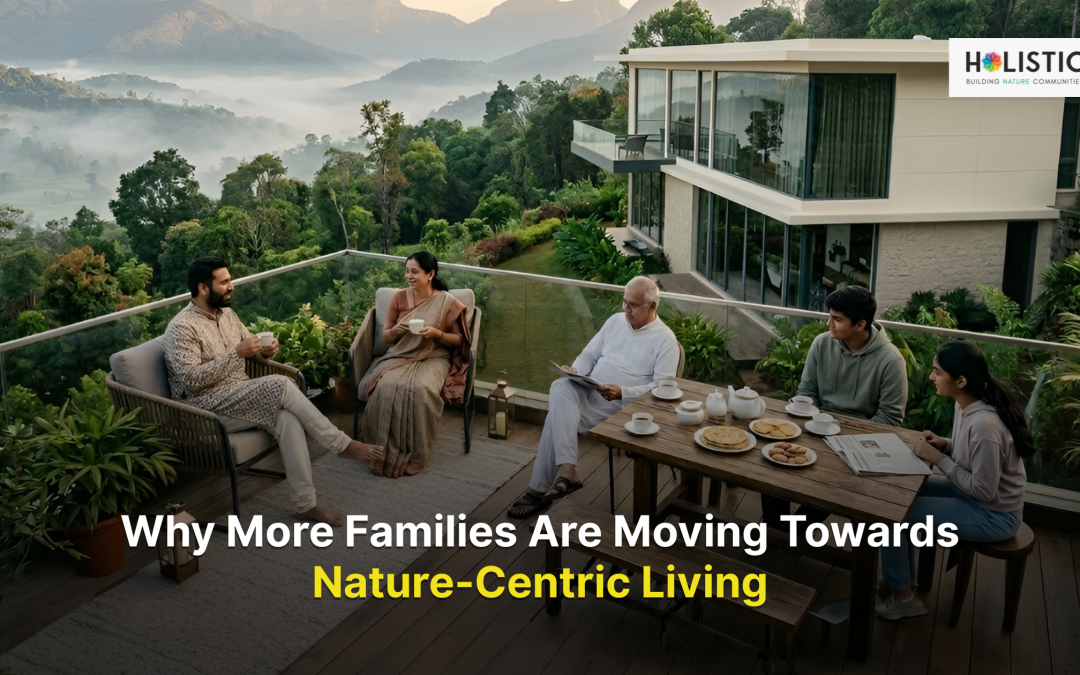
Why More Families Are Moving Towards Nature-Centric Living

Why More Families Are Moving Towards Nature-Centric Living

By Holistic Group | Lifestyle & Real Estate Insights | March 2026

It begins with a cough that won’t quit. Or a child glued to a screen in a sealed apartment while the city outside roars past. Or a professional waking at 3 a.m., scrolling, anxious, unable to name why. Across India’s metros, millions of families are experiencing the same quiet realisation: the city has taken something essential away from them.

And they are doing something about it.

Nature-centric living — the deliberate choice to design life around access to natural environments, clean air, and open spaces — is no longer the preserve of poets and retirees. It has become the defining lifestyle shift of this decade, embraced by young families, urban professionals, NRIs, and a growing tribe of parents who refuse to raise their children in concrete isolation.

India’s biophilic design market saw a 28% surge in project demand in 2025 alone, while lifestyle-driven communities near metros are recording unprecedented buyer interest. The movement is structural, not seasonal, and Holistic Group’s villa communities near Mumbai are built precisely for this moment.

So what is driving this shift? And what does nature-centric living actually mean in the Indian context?

What Is Nature-Centric Living?

Nature-centric living is a lifestyle philosophy that places the natural world at the center of how we design our homes, communities, and daily rhythms. It goes far beyond a few potted plants on a windowsill. It encompasses:

  • Nature-integrated communities: Gated developments built around forests, water bodies, organic farms, and open green corridors rather than roads and walls.
  • Wellness-first design: Homes with cross-ventilation, circadian lighting, and spaces for meditation, yoga, and outdoor movement.
  • Sustainable living practices: Solar-powered infrastructure and nature-first site planning integrated into the residential experience.
  • Proximity to nature: Choosing to live near forests, hills, rivers, and open landscapes — not as a holiday, but as a permanent lifestyle address.

The Drivers Behind the Nature-Centric Living Movement in India

1. Post-Pandemic Reckoning with Urban Life

The COVID-19 pandemic was the sharpest catalyst for this movement. Lockdowns transformed city apartments from convenience into cage-like experiences. Families who had traded green space for square footage discovered that those trade-offs had consequences. Outdoor space, fresh air, and access to nature — previously treated as luxuries — revealed themselves as non-negotiable aspects of healthy living.

The pandemic’s lingering effect on buyer psychology has been profound: demand for homes near open spaces, forests, and nature-integrated communities has not receded — it has accelerated.

2. The Mental Health and Wellness Imperative

India now confronts one of the world’s most significant mental health challenges. Urban stress, screen dependency, poor air quality, and the relentless pace of city life are driving anxiety, burnout, and chronic health problems across demographics. Research consistently shows that access to nature reduces cortisol levels, improves cognitive function, lowers blood pressure, and enhances overall mood.

A UN-Habitat study found that access to green spaces can reduce stress levels by up to 20% and improve overall life satisfaction. This is not abstract research to the families making relocation decisions — it is lived experience motivating real choices.

3. Parenting in Nature: A Generational Shift

A defining driver of the nature-centric living movement is parents. Indian parents — particularly in the 30–45 age bracket — are increasingly concerned about what urban environments are doing to their children. Screen addiction, reduced physical activity, diminished attention spans, and loss of connection with the natural world are real anxieties shaping significant real estate decisions.

Studies from developmental psychology suggest that children who spend regular time in nature show higher creativity, better emotional regulation, stronger immunity, and greater resilience. These findings are reshaping what families consider a good home.

For children, nature-centric communities near Mumbai offer more than open skies — they offer the kind of environment that shapes healthier, more grounded human beings.

4. The Remote Work Revolution

The rise of hybrid and remote work has fundamentally altered the geography of desirable living. For millions of Indian professionals, the daily commute to a Mumbai office is no longer the fixed anchor it once was. When location flexibility is available, the calculus shifts dramatically: why endure city pollution, traffic, and cramped living if one can work from a nature-integrated villa two hours from the city?

Nature-Centric Living Near Mumbai: The Geographic Opportunity

For Mumbai and Pune families, the geography surrounding the city offers an exceptional canvas for nature-centric living. The Western Ghats corridor — Karjat, Alibaug, Roha, Lonavala, and the Panvel-Neral belt — combines extraordinary natural beauty with improved road and rail connectivity.

Why Karjat Is India’s Premier Nature-Living Destination

  • Stunning monsoon landscape: Waterfalls, rivers, hills, and dense forest cover create one of Maharashtra’s most biodiverse environments
  • Under 2 hours from Mumbai by road and rail — making nature-centric living practically viable for working families
  • Dramatically improved by the Navi Mumbai International Airport (NMIA) — cutting effective travel time significantly
  • Clean air, natural water sources, and a cooler microclimate compared to coastal or urban alternatives
  • Rapidly appreciating property values — making it both a lifestyle and a financial decision

How Holistic Group’s Communities Embody Nature-Centric Living

Holistic Group was built on a simple belief: that the best homes aren’t just well-designed — they’re well-located, well-managed, and rooted in nature. Every project is planned around green surroundings, open spaces, and a lifestyle that lets residents breathe easier, literally and figuratively.

Trulife — Nestled in the green hills near Karjat, Trulife is a gated villa community where nature isn’t just a backdrop — it’s part of everyday life. Lush surroundings, resort-style amenities, and a fully managed environment make it one of the most sought-after addresses for families seeking a nature-close lifestyle near Mumbai.

Goodlife — Goodlife is designed for homeowners who want more than a home — a thoughtfully planned, nature-integrated gated community with premium amenities and the ease of fully managed living in the serene outskirts of Karjat.

Evernest Prime — Positioned near the DMIC corridor in Roha, Raigad, Evernest Prime offers managed villa plots within a wellness-themed community — combining scenic natural surroundings with a location primed for long-term value.

Who Is Making the Move to Nature-Centric Living?

  • Young Families with Children: Parents seeking outdoor-rich environments where children play in grass and learn from nature rather than screens. Gated green communities provide both safety and wildness.
  • Urban Professionals with Remote Flexibility: Those working hybrid schedules who want a second home or primary address in nature, within reach of city obligations but removed from city stress.
  • NRIs Returning to India: Indians who have experienced curated nature living abroad (New Zealand, Canada, Scandinavia) and refuse to settle for less upon return.
  • Wellness-Oriented Homebuyers: Those with yoga, Ayurveda, meditation, or health-conscious lifestyles who want their home environment to actively support their well-being.
  • Retirees and Senior Families: Those entering their golden years who want peace, community, clean air, and an environment that supports physical and mental ageing gracefully.
  • Real Estate Investors: Properties with integrated wellness features have seen value increases of up to 25% globally. Green villa communities near Mumbai represent both a lifestyle and a financial thesis.

Checklist: Is Nature-Centric Living Right for Your Family?

  1. Do you prioritise clean air, open space, and natural environments over urban proximity?
  2. Do you or your partner have remote or hybrid work flexibility?
  3. Are you concerned about the effects of urban stress and screen time on your children?
  4. Is wellness, sustainable living, or organic lifestyle central to your family’s values?
  5. Are you looking for a second home or primary address within 2 hours of Mumbai?
  6. Do you want your property investment to align with both lifestyle values and long-term appreciation?

If you answered yes to three or more, nature-centric living is not just appealing — it is aligned with who you are.

Continue Your Nature-Living Journey: Related Reading

Explore these related articles from Holistic Group’s knowledge library — each linked as part of a structured content silo to guide your decision-making journey:

Conclusion: Nature Is Not an Amenity. It Is a Foundation.

The shift towards nature-centric living represents one of the most important lifestyle movements of our era. It is driven not by nostalgia but by evidence — that humans think more clearly, feel better, and live longer when surrounded by the natural world. For families in India who have the opportunity to choose where they live, the conversation has fundamentally changed.

It is no longer about how many square feet. It is about how many trees. How much open sky? How clean the air is when you open your window in the morning. How your children run free. How do you feel when you wake up?

Holistic Group’s nature-integrated communities near Mumbai are built on this exact conviction. They are not selling homes — they are offering a different way of being alive in the world.

Nature-centric living is not a trend. It is the future coming into focus.

Best Areas to Invest in Mumbai 3.0 Near Navi Mumbai International Airport

Best Areas to Invest in Mumbai 3.0 Near Navi Mumbai International Airport

Introduction to Mumbai 3.0

Mumbai’s real estate landscape is evolving. The next chapter is unfolding beyond the traditional city limits. This transformation is widely referred to as Mumbai 3.0. It represents the metropolitan expansion toward Navi Mumbai, Panvel, and surrounding growth corridors influenced by the Navi Mumbai International Airport.

Mumbai 3.0 is not merely geographic expansion. It is infrastructural recalibration. It is a redistribution of economic gravity. Developers and planners are now building with foresight rather than retrofitting density.

What Is Mumbai 3.0 and Why It Matters

Mumbai 3.0 refers to the next urban development belt extending beyond Navi Mumbai into Panvel, Ulwe, Karjat, and adjoining nodes. Unlike Mumbai 1.0 (South Mumbai) and Mumbai 2.0 (Bandra–Andheri–Navi Mumbai), Mumbai 3.0 is infrastructure-led.

This region is being shaped by mega projects, multimodal connectivity, and airport-centric development. For investors, Mumbai 3.0 offers early-stage price discovery and long-term appreciation potential.

Forward-thinking developers such as Holistic Group have recognized this shift early, strategically focusing on emerging nodes like Karjat that align with the long-term growth blueprint of Mumbai 3.0.

The Strategic Importance of Navi Mumbai International Airport

The Navi Mumbai International Airport acts as the fulcrum of Mumbai 3.0. Airports stimulate commercial ecosystems, hospitality demand, logistics parks, and residential townships.

With global connectivity comes employment generation. With employment comes housing demand. Mumbai 3.0 is being structured around this economic multiplier. Residential formats—from apartments to gated villa communities—are expanding to meet this demand.

Invest in Mumbai 3.0

Infrastructure Catalysts Powering Mumbai 3.0

Mumbai Trans Harbour Link (MTHL), dedicated freight corridors, expanded suburban rail networks, and improved highway connectivity are reshaping mobility. Infrastructure compresses travel time. Time compression increases real estate value.

Mumbai 3.0 benefits from planned civic design rather than retrofitted urbanism. That distinction is critical. Organized developments in peripheral growth zones are gaining investor confidence.

Why Investors Are Eyeing Mumbai 3.0 Early

Early-cycle investments historically yield disproportionate returns. Mumbai 3.0 currently offers lower entry pricing compared to saturated Mumbai micro-markets.

Investors seeking land parcels, plotted developments, or villa communities are positioning themselves before full-scale commercialization stabilizes prices. In particular, curated nature-centric projects by developers like Holistic Group are attracting buyers looking for differentiated residential formats within Mumbai 3.0.

Mumbai 3.0

Ulwe: The Airport-Adjacent Growth Node

Ulwe sits closest to the Navi Mumbai International Airport footprint. Proximity enhances speculative appeal.

Residential demand in Ulwe is fueled by airport-linked employment expectations. As Mumbai 3.0 matures, Ulwe may witness accelerated capital movement and rapid absorption cycles.

Karjat: Nature-Driven Residential Growth in Mumbai 3.0

Karjat introduces a differentiated proposition within Mumbai 3.0. Unlike dense urban nodes, it offers nature-integrated living, villa communities, and plotted developments.

As connectivity improves, Karjat becomes attractive for second homes and gated communities aligned with lifestyle-oriented buyers. Developers such as Holistic Group are capitalizing on this trend by conceptualizing curated villa and farm-style communities that combine ecological aesthetics with structured planning.

Karjat’s positioning within Mumbai 3.0 is unique. It offers both appreciation potential and lifestyle arbitrage.

Also check Karjat Real Estate Boom: The Navi Mumbai Airport Effect

Panvel: The Gateway of Mumbai 3.0

Panvel is the administrative and transit nucleus of Mumbai 3.0. It connects rail, highway, and upcoming airport access corridors.

With educational institutions, commercial centers, and integrated townships emerging, Panvel presents balanced risk-reward potential. It is often considered the stabilizing anchor of Mumbai 3.0.

Dronagiri: The Emerging Investment Frontier

Dronagiri is positioned near port infrastructure and industrial zones. This dual advantage of port and airport connectivity strengthens Mumbai 3.0’s logistics narrative.

Industrial employment often precedes residential expansion. Investors looking for high-risk, high-reward positioning evaluate Dronagiri carefully within the broader Mumbai 3.0 ecosystem.

Pushpak Nagar: Planned Urban Expansion Zone

Pushpak Nagar is a CIDCO-planned node offering structured layouts and regulatory clarity. Planned infrastructure reduces compliance risk.

In Mumbai 3.0, disciplined urbanization is outperforming fragmented growth. Pushpak Nagar represents structured expansion aligned with long-term metropolitan planning.

Khalapur & Chowk: The Peripheral Appreciation Belt

Peripheral regions such as Khalapur and Chowk benefit from spillover demand. Land availability remains higher here compared to core nodes.

In Mumbai 3.0 cycles, peripheral belts often demonstrate delayed but exponential appreciation once core zones mature. Strategic land banking in these areas can generate asymmetric returns.

Connectivity Matrix: Road, Rail & Sea Links

Mumbai 3.0 integrates multimodal transport, including highways, suburban rail, metro extensions, and sea links. Connectivity is not singular. It is layered.

Layered connectivity enhances absorption rates. Absorption rates influence price stability. As infrastructure milestones are achieved, Mumbai 3.0’s investment thesis strengthens.

Comparison Table of Key Investment Zones in Mumbai 3.0

Comparative Overview of Prime Investment Nodes in Mumbai 3.0
Area Proximity to Airport Investment Type Risk Level Appreciation Potential
Panvel Moderate Apartments & Townships Medium High
Ulwe Very Close Apartments Medium-High High
Karjat Extended Belt Villas & Plots Medium High (Long Term)
Pushpak Nagar Moderate Planned Residential Medium Stable-High
Dronagiri Close Mixed Use High Very High

Each node within Mumbai 3.0 presents distinct investment archetypes. Diversification across nodes can optimize risk-adjusted returns.

Residential vs Plot Investment in Mumbai 3.0

Apartments offer rental yield consistency. Plots and villas offer appreciation asymmetry. Mumbai 3.0 still provides plotted opportunities rarely available in mature urban centers.

Strategic diversification across asset classes within Mumbai 3.0 can mitigate volatility. Nature-centric plotted and villa communities, especially in Karjat, are gaining traction among long-horizon investors..

plot investment Mumbai 3.0

Rental Yield vs Capital Appreciation Potential

Airport-led regions typically witness stronger capital appreciation initially, followed by rental stabilization. Mumbai 3.0 may follow this pattern.

Short-term rental yields could remain moderate. Long-term capital growth appears structurally stronger, particularly in growth corridors supported by reputed developers and planned infrastructure.

Risks and Due Diligence Checklist

Verify RERA compliance. Assess land titles. Study infrastructure timelines. Avoid speculative over-leverage.

Mumbai 3.0 offers opportunity, but disciplined due diligence ensures capital preservation. Choosing established developers such as Holistic Group in emerging nodes reduces execution risk and enhances investment confidence.

Who Should Invest in Mumbai 3.0?

Long-term investors, NRIs, second-home buyers, and portfolio diversifiers benefit most from Mumbai 3.0 exposure.

Investors seeking villa communities, plotted developments, or eco-integrated residential formats may find Karjat and similar nodes particularly compelling within the Mumbai 3.0 framework.

Frequently Asked Questions

Is Mumbai 3.0 a government-declared project?

Mumbai 3.0 is an industry term describing the next phase of metropolitan expansion influenced by Navi Mumbai International Airport and surrounding infrastructure. It reflects market evolution rather than a singular government notification.

Which area in Mumbai 3.0 has the highest growth potential?

Ulwe and Panvel currently demonstrate strong growth indicators due to airport proximity and infrastructure readiness. However, Karjat and other peripheral nodes may outperform over longer investment horizons within Mumbai 3.0.

Is investing in Mumbai 3.0 risky?

All early-cycle investments carry risk. However, infrastructure-backed expansion reduces structural uncertainty. Thorough due diligence and selecting credible developers mitigate exposure.

How soon will Mumbai 3.0 see price appreciation?

Appreciation is typically phased, aligning with infrastructure milestones and airport operational timelines. Early positioning within Mumbai 3.0 generally yields better entry pricing.

Conclusion: The Long-Term Outlook of Mumbai 3.0

Mumbai 3.0 represents an infrastructural renaissance rather than speculative hype. The convergence of airport development, multimodal transport, and planned residential expansion creates a strong macroeconomic thesis.

Investors who evaluate nodes carefully, diversify asset types, and align with infrastructure timelines are likely to benefit from Mumbai 3.0’s multi-year growth trajectory. Strategic participation through structured, reputable developers—such as Holistic Group—can further enhance investment stability within this transformative phase of Mumbai 3.0.