It begins with a cough that won’t quit. Or a child glued to a screen in a sealed apartment while the city outside roars past. Or a professional waking at 3 a.m., scrolling, anxious, unable to name why. Across India’s metros, millions of families are experiencing the same quiet realisation: the city has taken something essential away from them.
And they are doing something about it.
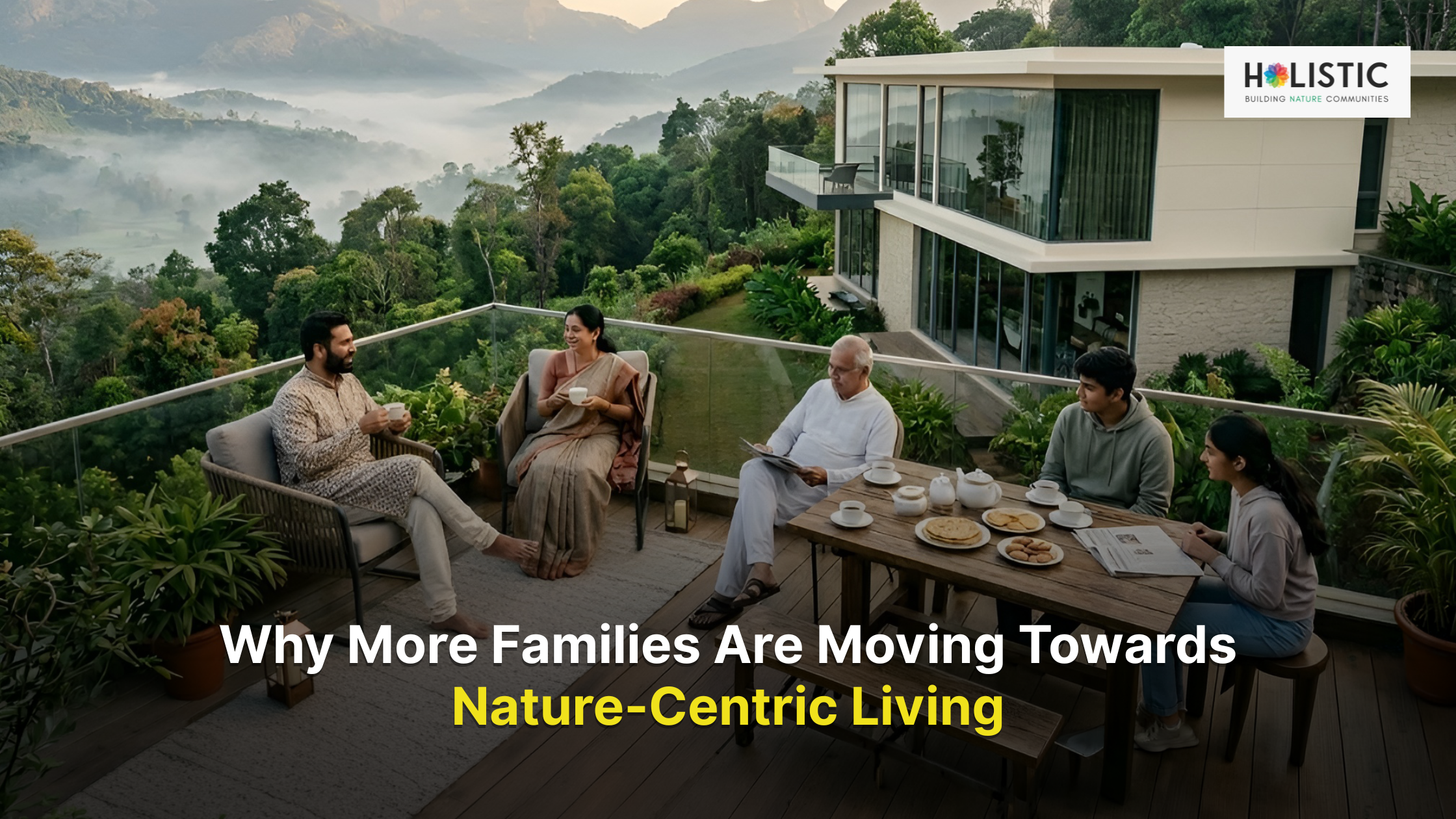
Nature-centric living — the deliberate choice to design life around access to natural environments, clean air, and open spaces — is no longer the preserve of poets and retirees. It has become the defining lifestyle shift of this decade, embraced by young families, urban professionals, NRIs, and a growing tribe of parents who refuse to raise their children in concrete isolation.
India’s biophilic design market saw a 28% surge in project demand in 2025 alone, while lifestyle-driven communities near metros are recording unprecedented buyer interest. The movement is structural, not seasonal, and Holistic Group’s villa communities near Mumbai are built precisely for this moment.
So what is driving this shift? And what does nature-centric living actually mean in the Indian context?
What Is Nature-Centric Living?
Nature-centric living is a lifestyle philosophy that places the natural world at the center of how we design our homes, communities, and daily rhythms. It goes far beyond a few potted plants on a windowsill. It encompasses:
- Nature-integrated communities: Gated developments built around forests, water bodies, organic farms, and open green corridors rather than roads and walls.
- Wellness-first design: Homes with cross-ventilation, circadian lighting, and spaces for meditation, yoga, and outdoor movement.
- Sustainable living practices: Solar-powered infrastructure and nature-first site planning integrated into the residential experience.
- Proximity to nature: Choosing to live near forests, hills, rivers, and open landscapes — not as a holiday, but as a permanent lifestyle address.
The Drivers Behind the Nature-Centric Living Movement in India
1. Post-Pandemic Reckoning with Urban Life
The COVID-19 pandemic was the sharpest catalyst for this movement. Lockdowns transformed city apartments from convenience into cage-like experiences. Families who had traded green space for square footage discovered that those trade-offs had consequences. Outdoor space, fresh air, and access to nature — previously treated as luxuries — revealed themselves as non-negotiable aspects of healthy living.
The pandemic’s lingering effect on buyer psychology has been profound: demand for homes near open spaces, forests, and nature-integrated communities has not receded — it has accelerated.
2. The Mental Health and Wellness Imperative
India now confronts one of the world’s most significant mental health challenges. Urban stress, screen dependency, poor air quality, and the relentless pace of city life are driving anxiety, burnout, and chronic health problems across demographics. Research consistently shows that access to nature reduces cortisol levels, improves cognitive function, lowers blood pressure, and enhances overall mood.
A UN-Habitat study found that access to green spaces can reduce stress levels by up to 20% and improve overall life satisfaction. This is not abstract research to the families making relocation decisions — it is lived experience motivating real choices.
3. Parenting in Nature: A Generational Shift
A defining driver of the nature-centric living movement is parents. Indian parents — particularly in the 30–45 age bracket — are increasingly concerned about what urban environments are doing to their children. Screen addiction, reduced physical activity, diminished attention spans, and loss of connection with the natural world are real anxieties shaping significant real estate decisions.
Studies from developmental psychology suggest that children who spend regular time in nature show higher creativity, better emotional regulation, stronger immunity, and greater resilience. These findings are reshaping what families consider a good home.
For children, nature-centric communities near Mumbai offer more than open skies — they offer the kind of environment that shapes healthier, more grounded human beings.
4. The Remote Work Revolution
The rise of hybrid and remote work has fundamentally altered the geography of desirable living. For millions of Indian professionals, the daily commute to a Mumbai office is no longer the fixed anchor it once was. When location flexibility is available, the calculus shifts dramatically: why endure city pollution, traffic, and cramped living if one can work from a nature-integrated villa two hours from the city?
Nature-Centric Living Near Mumbai: The Geographic Opportunity
For Mumbai and Pune families, the geography surrounding the city offers an exceptional canvas for nature-centric living. The Western Ghats corridor — Karjat, Alibaug, Roha, Lonavala, and the Panvel-Neral belt — combines extraordinary natural beauty with improved road and rail connectivity.
Why Karjat Is India’s Premier Nature-Living Destination
- Stunning monsoon landscape: Waterfalls, rivers, hills, and dense forest cover create one of Maharashtra’s most biodiverse environments
- Under 2 hours from Mumbai by road and rail — making nature-centric living practically viable for working families
- Dramatically improved by the Navi Mumbai International Airport (NMIA) — cutting effective travel time significantly
- Clean air, natural water sources, and a cooler microclimate compared to coastal or urban alternatives
- Rapidly appreciating property values — making it both a lifestyle and a financial decision
How Holistic Group’s Communities Embody Nature-Centric Living
Holistic Group was built on a simple belief: that the best homes aren’t just well-designed — they’re well-located, well-managed, and rooted in nature. Every project is planned around green surroundings, open spaces, and a lifestyle that lets residents breathe easier, literally and figuratively.
Trulife — Nestled in the green hills near Karjat, Trulife is a gated villa community where nature isn’t just a backdrop — it’s part of everyday life. Lush surroundings, resort-style amenities, and a fully managed environment make it one of the most sought-after addresses for families seeking a nature-close lifestyle near Mumbai.
Goodlife — Goodlife is designed for homeowners who want more than a home — a thoughtfully planned, nature-integrated gated community with premium amenities and the ease of fully managed living in the serene outskirts of Karjat.
Evernest Prime — Positioned near the DMIC corridor in Roha, Raigad, Evernest Prime offers managed villa plots within a wellness-themed community — combining scenic natural surroundings with a location primed for long-term value.
Who Is Making the Move to Nature-Centric Living?
- Young Families with Children: Parents seeking outdoor-rich environments where children play in grass and learn from nature rather than screens. Gated green communities provide both safety and wildness.
- Urban Professionals with Remote Flexibility: Those working hybrid schedules who want a second home or primary address in nature, within reach of city obligations but removed from city stress.
- NRIs Returning to India: Indians who have experienced curated nature living abroad (New Zealand, Canada, Scandinavia) and refuse to settle for less upon return.
- Wellness-Oriented Homebuyers: Those with yoga, Ayurveda, meditation, or health-conscious lifestyles who want their home environment to actively support their well-being.
- Retirees and Senior Families: Those entering their golden years who want peace, community, clean air, and an environment that supports physical and mental ageing gracefully.
- Real Estate Investors: Properties with integrated wellness features have seen value increases of up to 25% globally. Green villa communities near Mumbai represent both a lifestyle and a financial thesis.
Checklist: Is Nature-Centric Living Right for Your Family?
- Do you prioritise clean air, open space, and natural environments over urban proximity?
- Do you or your partner have remote or hybrid work flexibility?
- Are you concerned about the effects of urban stress and screen time on your children?
- Is wellness, sustainable living, or organic lifestyle central to your family’s values?
- Are you looking for a second home or primary address within 2 hours of Mumbai?
- Do you want your property investment to align with both lifestyle values and long-term appreciation?
If you answered yes to three or more, nature-centric living is not just appealing — it is aligned with who you are.
Continue Your Nature-Living Journey: Related Reading
Explore these related articles from Holistic Group’s knowledge library — each linked as part of a structured content silo to guide your decision-making journey:
- → Green Villas & Spaces: The Future of Real Estate — How green villa communities are reshaping the future of sustainable real estate investment in India.
- → Luxury Villa Sustainable Living at Trulife — A deep dive into how Trulife’s nature-integrated architecture delivers wellness and sustainable luxury in one address.
- → Green Real Estate India: Trends & Opportunities — Understand the macro trends driving eco-friendly real estate demand across India’s key markets.
- → Farmhouse in Raigad: The Perfect Nature Escape — Explore why Raigad’s natural beauty and connectivity make it ideal for families seeking an organic living escape.
- → Why Karjat Is the Perfect Location for Your Next Luxury Villa — A comprehensive guide to why Karjat stands out as India’s premier destination for nature-centric luxury villa living.
- → Villas in Karjat: A Lifestyle Beyond the Ordinary — Discover the lifestyle benefits — from monsoon forests to village culture — that make Karjat villa living unlike anywhere else.
- → Gated Second Home Communities for Professionals — How nature-integrated gated communities are tailored to meet the lifestyle needs of modern Indian professionals.
- → Retiring in India: Karjat Senior Living for NRIs — Why Karjat’s nature-centric wellness communities are becoming the preferred retirement destination for returning NRIs.
Conclusion: Nature Is Not an Amenity. It Is a Foundation.
The shift towards nature-centric living represents one of the most important lifestyle movements of our era. It is driven not by nostalgia but by evidence — that humans think more clearly, feel better, and live longer when surrounded by the natural world. For families in India who have the opportunity to choose where they live, the conversation has fundamentally changed.
It is no longer about how many square feet. It is about how many trees. How much open sky? How clean the air is when you open your window in the morning. How your children run free. How do you feel when you wake up?
Holistic Group’s nature-integrated communities near Mumbai are built on this exact conviction. They are not selling homes — they are offering a different way of being alive in the world.
Nature-centric living is not a trend. It is the future coming into focus.